HUD Homes And The Three Appraisal Conditions

by Michael on April 27, 2012

There always seems to be some confusion when it comes to appraisals and HUD homes regarding the insurable code that was assigned to it. For every HUD home listing, the appraiser that did the appraisal determined what it’s going to take for the property to meet HUD’s minimum property standards (MPS). The home has also had an inspection preformed by a third party to help to determine the property’s condition, with the results put in what is called the PCR (property conditions report). If a potential buyer wants to purchase a HUD home using FHA financing then understanding these codes will help to determine if the home can qualify, and if so under what conditions.

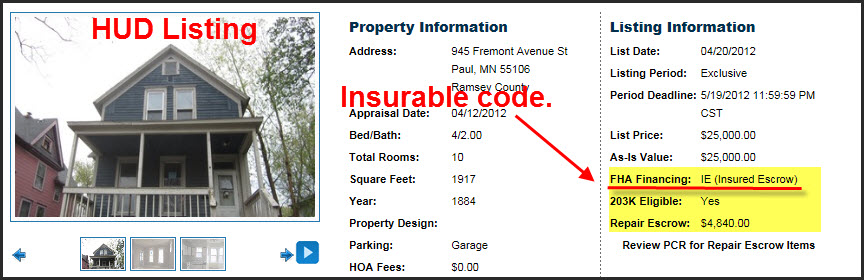
As you can see from the picture above that this property will qualify for FHA financing, however, there are is work that needs to be done, which is why there’s an escrow for funds until the work has been completed. It’s highly recommended that if you’re interested in purchasing a HUD home that you find a mortgage officer that has experience in dealing with this type of lending.

Glossary for HUD Insurable Terms

Here’s a link to the HUD Home Store if you’re interested in seeing what homes are currently for sale. Below is a glossary for the insurable terms used in HUD’s listings.

  • IE = Insurable. with repair escrow. This property requires repairs estimated to cost no more than $5,00o; it is eligible for an FHA-insured loan provided the purchaser’s lender sets up a repair escrow at closing.
  • IN = Insurable. This property is eligible for an FHA-insured loan in its current condition.
  • UI = Uninsured. This property requires repairs estimated to cost more that $5,000; it is not eligible for an FHA-insured loan, unless a 203K loan can be arranged. Follow this link for more information on HUD’s 203K programs.

Things To Consider When Buying a HUD Home Regarding Condition

There are two things that I would highly recommend when purchasing a HUD home. First, try and get a copy of the appraisal that was completed for HUD. Many times there are deferred maintenance issues that have been listed in the appraisal, and the cost cure them. Deferred maintenance items aren’t required to be repaired to meet FHA minimum property standards, however, they can have an effect on value.

Second, get a copy of the PCR that was done for HUD. This is a very succinct inspection report, but it does cover the main issues that are required to meet FHA’s minimum property standards.

Should You Still Have a Home Inspection

I’ve heard from real estate agents that buyers seem to want to forgo the expense of having a home inspection done when buying a HUD home, being that there has already been two inspections completed; both by the appraiser and the company that did the PCR inspection for HUD.

I’m of the opinion that neither were intended to replace an inspection by a professional home inspector. I would highly recommend getting a home inspection; HUD homes have sometimes been sitting vacant for many months, and should be thoroughly inspected prior to purchasing.


{ 1 comment }

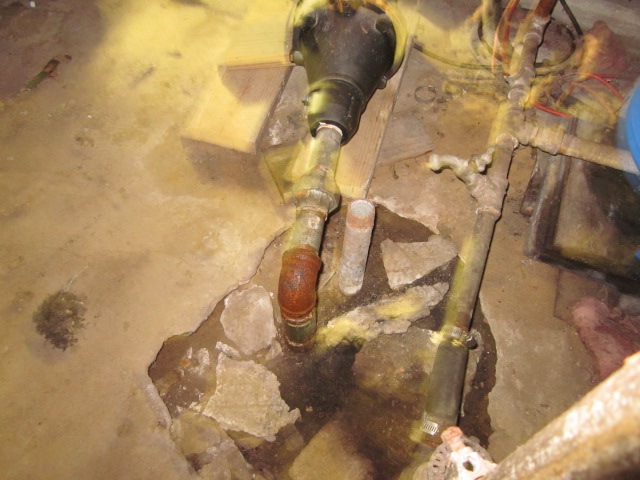
When doing FHA appraisals the appraiser is required to do what is called the “Head and Shoulders” test. The appraiser is required to inspect the attic and basement/crawl space to at least the head and shoulders level. The appraiser should use a flashlight or similar device to illuminate the space being inspected; photographs are required for any deficiencies to document any needed repairs, or other required inspections by a third party.


Things appraiser’s look for:

  • Proper ventilation of the roof or attic area.
  • Hazards (missing/loose duct work, wiring, etc.)
  • Hole in the fire barrier wall between the house and garage.
  • Leaking roof, and/or any water or moisture damage to sheathing or roof trusses.
  • Standing or pools of water (crawl space).
  • Structural problems.


Appraisers must have access to the attic and crawl space. If this area is blocked then the lender will have to be contacted and reschedule an inspection. This would most likely result in an unwanted re-inspection fee. It’s not the responsibility of the appraiser to move homeowner’s personal belongings and furniture to gain access (can you say major liability issues). Some attic spaces do have more than one access entry point, and depending on the area that the appraiser is able view, both may have to be made available.


If the appraiser is unable to gain access:

  • Lender will be contacted to reschedule the inspection.
  • If access isn’t feasible, then the appraisal is conditioned upon a satisfactory inspection by a qualified third party.
  • If the design is such that an inspection isn’t possible (flat roofs, vaulted ceilings, etc.) then the appraiser will indicate that within their report.

It’s important to note that FHA requires that the attic and/or crawl space to be inspected; sealed scuttle doors, clutter/furniture blocking entry doesn’t qualify as reasons that an inspection can’t be done.

If you have any concerns about any of the above issues please feel free to contact me for clarification.


{ 0 comments }

Becoming An Appraiser Is Going To Get More Difficult

April 23, 2012

Last year the Appraiser Qualifications Board made changes to the criteria for becoming an appraiser. Starting in January 1,2015 all licensed appraisers wishing to upgrade their license to become a certified and general appraiser will be now have to have a bachelor’s degree from an accredited college. First, I’m all for raising the standards of appraisers, however, [...]

Read the full article →

A House Or Hotel For The Birds

April 8, 2012

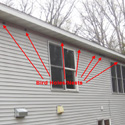
At first glance it would seem pretty harmless to have just one piece of siding missing on a house, but that’s unless the birds decided to turn it into their own hotel. All along the back of this house were several holes that the birds burrowed through the sheathing to build their nests. This would [...]

Read the full article →

3 Ways To Help Determine If Values Are Declining Or Increasing

April 4, 2012
Thumbnail image for 3 Ways To Help Determine If Values Are Declining Or Increasing

For every appraisal done on the Fannie Mae Form 1004 appraisers have to figure out what’s happening with current values (the past 12 months) within a given properties neighborhood and/or market area. Short term market trends differ from long term trends, but Fannie Mae tends to be more concerned with what’s been happening within the past 12 months. Given the [...]

Read the full article →

Housing Trivia: Who Invented Sheetrock

April 1, 2012

Who invented Sheetrock is kind of a trick question, because Sheetrock® is really a product brand invented by United States Gypsum Company, and patented in 1917. However, Augustine Sackett is recognized as the the actual inventor of gypsum board (drywall) in 1894. History Timeline Here’s a brief timeline of the development of drywall as we know it [...]

Read the full article →

The Tale Of A Low Appraisal

March 21, 2012

The Tale Of A Low Appraisal It all started on a mid-afternoon day in the middle of January (last year), with the wind howling and the air so cold that your spit would freeze before it hit the ground. The phone was quiet, the dog was snoring, and then I heard the ding of an incoming email. Yahoo! An [...]

Read the full article →

Housing Trivia: Who Invented Toilet Paper

March 20, 2012

The last housing trivia post was about who invented the first flush toilet, so I felt it was only fitting to unravel the mystery of who invented toilet paper. Heck, what good is a toilet if you don’t have a fluffy roll of “TP” to go with it. First, I was surprised that there were several [...]

Read the full article →

Don’t Blame The Appraiser, Blame the Underwriter!

March 16, 2012

I recently finished an appraisal for the sale of a hobby farm that turned out to be fairly difficult. The biggest challenge was to find comparable sales that had a similar out building. This was no ordinary building; it was over 4500 square feet with an insulated shop area, tack room, and eight horse stalls. Typically [...]

Read the full article →

How To Measure a Condo For An Appraisal

March 15, 2012

Measuring a condominium for an appraisal is fairly simple and easy to do, that is unless you have a grain silo that’s been turned into condominiums. I appraised one of these units several years ago, which was quite the challenge due to the round walls. For this example I think we’ll stick to the traditional squared walls. [...]

Read the full article →